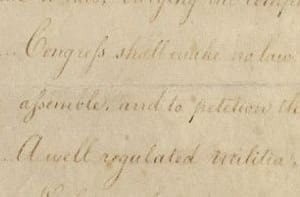
On September 25, 1789, the First Congress finished twelve proposed amendments to the new Constitution. They sat in Federal Hall on Wall Street in New York. The Constitution had gone into force without a separate bill of rights, and several states had ratified only on the promise that more guarantees would follow. James Madison of Virginia had brought the work to the House that June. By late September the House and Senate agreed on a final list. Speaker Frederick Muhlenberg and Vice President John Adams signed the engrossed parchment. Twelve articles stood on one sheet headed “Congress of the United States.”
Madison drew his proposals from the rights lists the states had sent with their ratifications. He wanted the country to see that Congress meant to secure what people had fought for. The House and Senate cut and reshaped the list through the summer until twelve articles remained.
A few days after the final vote, President George Washington had official copies made. On October 2, 1789, he sent them to the governors of the eleven states already in the Union, and to Rhode Island and North Carolina as well.
Ratification took more than two years. On December 15, 1791, when Virginia finished its action, three-fourths of the states had approved Articles 3 through 12. Those ten became the Bill of Rights. The original Article 2, on congressional pay, waited until 1992 and is now the Twenty-Seventh Amendment. Article 1, on the size of the House, was never ratified.
The parchment with all twelve articles still rests in the Rotunda of the National Archives in Washington.
Our Constitution with Quill Ornament (ChemArt) is solid brass, finished in 24k gold, and made in America. If you want the charter itself on the tree, the National Archives Bill of Rights Ornament is the matching brass piece when it is back in stock.