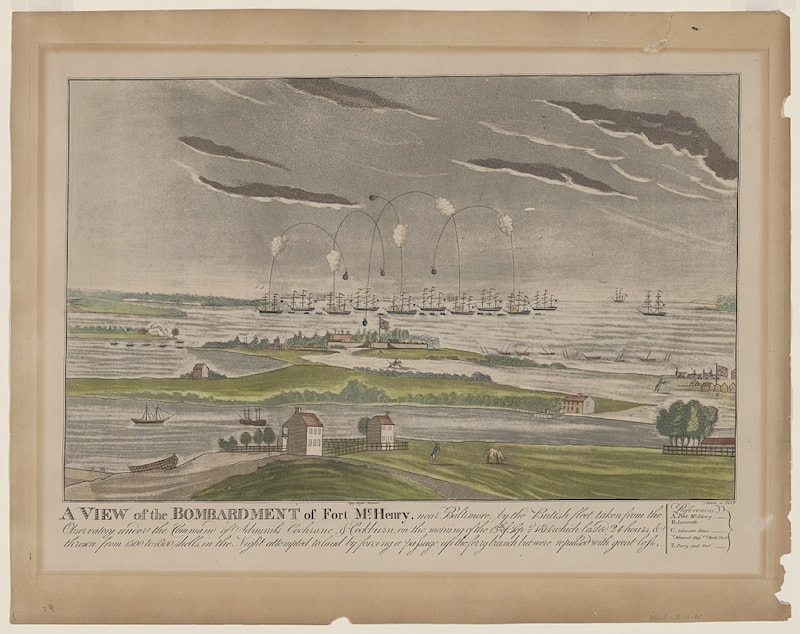
At dawn on September 14, 1814, Major George Armistead ordered his men to take down the battered storm flag over Fort McHenry and raise the great garrison flag. The banner was thirty feet by forty-two feet, sewn the summer before by Baltimore flag maker Mary Pickersgill with her daughter, two nieces, and an indentured African American girl. Fifteen stars. Fifteen stripes. Each star about two feet across. From a ninety-foot pole it could be seen for miles down the Patapsco.
Three weeks earlier, during the War of 1812, British troops had burned the President's House in Washington. President James Madison and Dolley Madison had fled. The Capitol smoked. Admiral Alexander Cochrane's fleet then turned on Baltimore, then America's third-largest city, hoping to break the young republic at its busiest port.
On the morning of September 13, Cochrane's bomb and rocket ships opened fire. The bombardment ran about twenty-five hours. Ten- and thirteen-inch shells burst overhead. Congreve rockets scratched red lines across the sky. About a thousand Americans held the fort. Their own guns could not reach the distant ships until the British edged closer and American fire drove them back. Through a heavy rain, Armistead kept the smaller storm flag flying. By 7:30 on the morning of the 14th, Cochrane called off the attack. The fleet withdrew. Baltimore held.
Eight miles downriver, Georgetown lawyer Francis Scott Key had watched the night from a truce ship. He had come with John S. Skinner, the American agent for prisoner exchanges, to free Dr. William Beanes of Upper Marlboro, held by the British after the Washington campaign. They won Beanes's release, then were kept aboard until the assault on the fort was over, so they could not warn the city. When Key saw the big garrison flag still up in the first light, he began drafting lines on the back of a letter. Back in Baltimore on September 16, he took a room at the Indian Queen Hotel and copied out four verses. His brother-in-law, Judge Joseph Nicholson, who had commanded volunteers at the fort, urged him to print it. The broadside went out under the title "The Defence of Fort M'Henry," set to the British tune "Anacreon in Heaven." Soon people were calling the song "The Star-Spangled Banner."
The Armistead family kept the garrison flag as a battle memento. In 1907 Eben Appleton, Armistead's grandson, lent it to the Smithsonian. In 1912 he made the gift permanent. The flag still hangs in the National Museum of American History, a short walk from the rebuilt White House. On March 3, 1931, President Herbert Hoover signed the act of Congress that made Key's song the national anthem of the United States.
Our 2022 White House Heritage Collection ornament of the East Room looks back to that same August and September. Through light and shadow it centers Gilbert Stuart's portrait of George Washington, the painting Dolley's household saved the night the President's House burned. Finished in 24k gold on brass, made in America. The house was rebuilt. The flag that Key saw still exists. The song still opens with that morning.
See the 2022 East Room ornament. Collect the rest of the White House Heritage Collection.