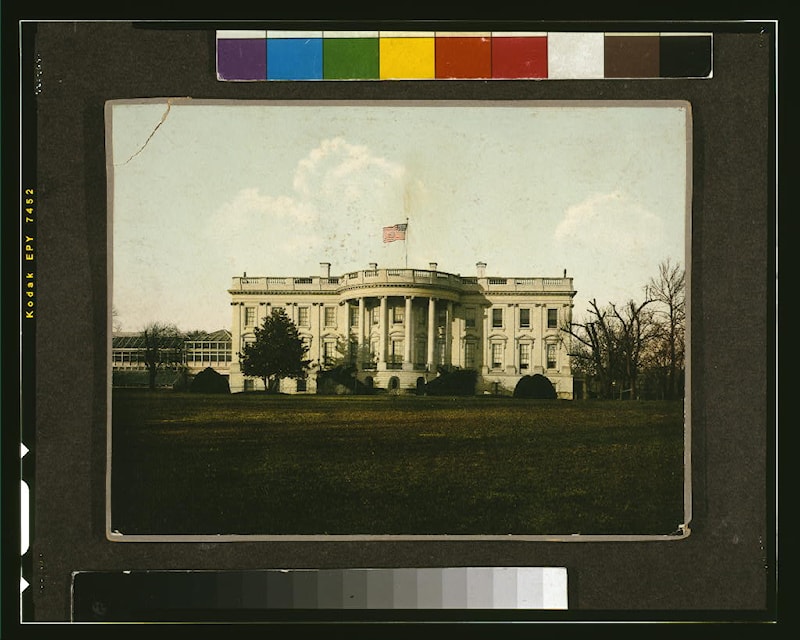
On September 4, 1970, from San Clemente, California, President Richard Nixon signed Proclamation 4000. From that day on, the American flag over the White House was to fly day and night, "except when the weather is inclement."
For most of the nineteenth century the flag came and went. It went up for holidays and ceremonies. The first lasting display on the grounds dates to June 1861, early in the Civil War, when Abraham Lincoln raised a flag from the South Lawn as a public show of the Union. Later the flag moved to the roof. By the mid-twentieth century the custom was sunrise to sunset, the same rule Congress had written into the Flag Code during World War II. At dusk the staff brought it down. At dawn they ran it up again.
First Lady Pat Nixon wanted something different. Visitors and letter writers kept asking why the Capitol, the Washington Monument, and the Lincoln Memorial glowed after dark while the people's house went dark. She urged a change. The proclamation itself says the White House "belongs to all the people," that families come to look at it at night, and that it is right for the flag to fly there by night as well as by day.
That fall she finished the other half of the idea. On November 25, 1970, Thanksgiving eve, Mrs. Nixon pressed a button on the South Lawn and turned on the new exterior lights, paid for with leftover 1969 inaugural funds. The Marine Band played "America the Beautiful." For the first time the house itself stayed lit after dark, and the flag on the roof could be seen with it.
The rule has held. Half-staff days still come, and storms still take the flag down. But on an ordinary night in Washington, if you walk past the fence after sunset, the Stars and Stripes are still up there.
Our 13 Colonies 1776 American Flag Ornament carries the Betsy Ross thirteen-star design. An officially licensed America250 keepsake.
See the 13 Colonies 1776 American Flag Ornament.