The Colony That Hosted the Revolution Was the Last to Join It.
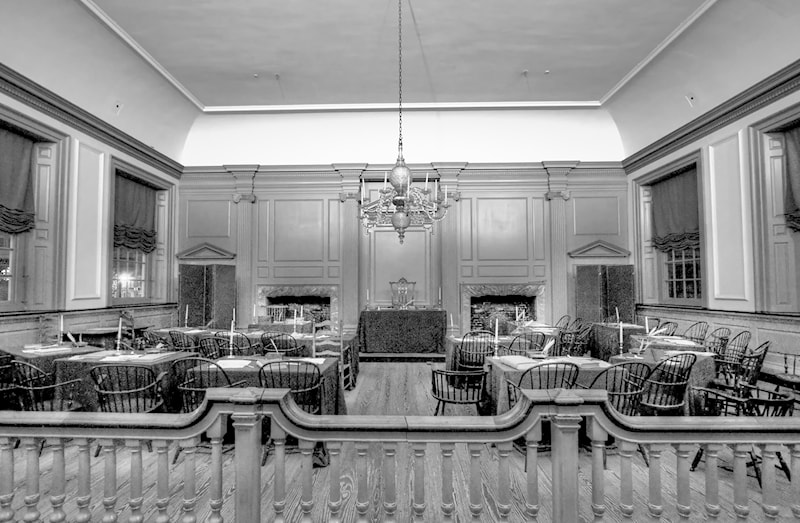
Pennsylvania is where the Declaration of Independence was signed. Independence Hall is in Philadelphia. The Continental Congress met there. Benjamin Franklin lived there. Every iconic image of the Revolution, the candle-lit room and the signatures at the bottom of the page, comes from Pennsylvania.
And yet Pennsylvania was one of the last colonies to authorize its delegates to vote for independence. Its Provincial Assembly, dominated by Quakers and conservatives, had spent the spring of 1776 explicitly instructing its delegates to oppose any resolution of separation from Britain.
The way around this was a revolution within a revolution. On June 18, 1776, while the Provincial Assembly was still paralyzed, a Conference of Committees representing every county in Pennsylvania met in Philadelphia, at Carpenter's Hall, where the First Continental Congress had met two years earlier. They had no legal authority. They took it anyway.
The Quaker Colony
Pennsylvania had been founded in 1681 by William Penn as a refuge for Quakers. Pacifism was not a fringe belief in Pennsylvania. It was the foundational creed of the governing elite. For nearly a century, the Pennsylvania Assembly had been dominated by Quakers who would not authorize military spending or consent to any war.
In the spring of 1776, this made Pennsylvania an obstacle. The Continental Congress was meeting inside Pennsylvania's capital city, debating a resolution to declare war, and Pennsylvania's own delegates, John Dickinson foremost among them, were voting against it.
Dickinson was not a Quaker himself, but he had risen through the Quaker political system and shared many of its instincts. He had written the most famous pro-American pamphlets of the previous decade, the "Letters from a Farmer in Pennsylvania," arguing against British taxation. But he drew the line at independence. He believed reconciliation was still possible and that a premature declaration would doom the colonies to a war they could not win.
The Conference of Committees
By June 1776, the pro-independence faction in Pennsylvania had run out of patience. They could not convince the Provincial Assembly to change its instructions. So they did what the Virginia Convention had done, and what the Massachusetts House had done. They went around the existing legislature.
Every county in Pennsylvania elected delegates to a Conference of Committees. On June 18, 1776, one hundred and eight delegates assembled at Carpenter's Hall. They chose Thomas McKean of the Lower Counties (yes, the same McKean who was simultaneously representing Delaware in Congress) as their president.
The Conference's first major act was a resolution declaring that Pennsylvania's people had "willingness to concur in a vote of the Continental Congress declaring the United Colonies free and independent States." They also called for a constitutional convention to replace the colonial government entirely.
That resolution was the political cover Pennsylvania's pro-independence delegates needed. The old Provincial Assembly still technically existed, but it was no longer the voice of the colony. The Conference had spoken for the people, and the people wanted out.
The July 2 Vote
When the Continental Congress voted on the Lee Resolution for independence on July 2, Pennsylvania's delegation was split. John Dickinson and Robert Morris abstained, deliberately absenting themselves so the delegation could vote yes. Benjamin Franklin, John Morton, and James Wilson voted yes. Thomas Willing and Charles Humphreys voted no.
The final tally for Pennsylvania: 3-2 in favor of independence. Dickinson and Morris had walked out so the motion could pass. It was one of the most selfless acts in the history of American politics, two men sacrificing their own positions so that their colony could vote yes.
John Morton, a Delaware County farmer of Swedish descent, cast what was arguably the decisive vote. Without him, Pennsylvania's delegation would have deadlocked. Independence would have failed.
The Keystone State
Pennsylvania's nickname is the Keystone State. In an arch, the keystone is the central wedge that locks all the other stones in place. Pennsylvania was the middle of the thirteen colonies by almost any measure in 1776. It was the wealthiest colony and the most ethnically diverse, and Philadelphia was the biggest port between New York and Charleston.
When Pennsylvania's Conference of Committees voted for independence on June 18, 1776, it locked the arch. Without Pennsylvania, the Declaration would have had a hole in its middle. With Pennsylvania, it was complete.
We commemorate Pennsylvania on our 50 State Heritage Collection ornament.