New Jersey Arrested Its Own Governor.
On June 15, 1776, the New Jersey Provincial Congress took the unprecedented step of arresting the sitting royal governor, William Franklin. He was removed from his residence in Perth Amboy, declared an "enemy of the liberties of this country," and placed under guard. Within days he would be exiled to Connecticut, where he spent much of the war in prison.
William Franklin was the son of Benjamin Franklin.
Six days later, on June 21, 1776, the Provincial Congress in Burlington passed a resolution authorizing New Jersey's delegates in the Continental Congress to vote for independence. The resolution passed unanimously. With the royal governor in chains and a new slate of delegates sent to Philadelphia, New Jersey cleared the last obstacle between itself and a declaration of independence.
The Franklin Family Split
The estrangement between Benjamin and William Franklin is one of the most heartbreaking personal stories of the Revolution. William was Benjamin's illegitimate son, but they had been close for decades. They had flown kites in thunderstorms together. William had helped his father with his electricity experiments. In 1762, Benjamin had used his influence to secure William's appointment as royal governor of New Jersey, a position William held for the next fourteen years.
William was a competent governor. He was popular with New Jersey's leading families. He was also, unlike his father, a committed Loyalist. As the Revolution approached, the two Franklins could not reconcile. In 1775, Benjamin traveled to New Jersey to try to convince William to come over to the Patriot side. The meeting ended in a bitter argument. They never had a real conversation again.
When William refused to dissolve the New Jersey Assembly in June 1776 as the Provincial Congress demanded, he was arrested. Benjamin, in Philadelphia helping draft the Declaration of Independence, took no action to intervene. William's son, Benjamin's grandson Temple Franklin, was sent to live with Benjamin in Europe during the war. It was the Franklin family's way of choosing sides.
The Crossroads Colony
New Jersey was often called the "crossroads of the Revolution," and it earned the name. More military engagements took place on New Jersey soil than in any other state, over 600 battles and skirmishes over the course of the war. The reason was geography. New Jersey sat between the two most strategic cities in British America: New York City and Philadelphia. Whichever army held New Jersey's roads controlled the ability to move between those two capitals.
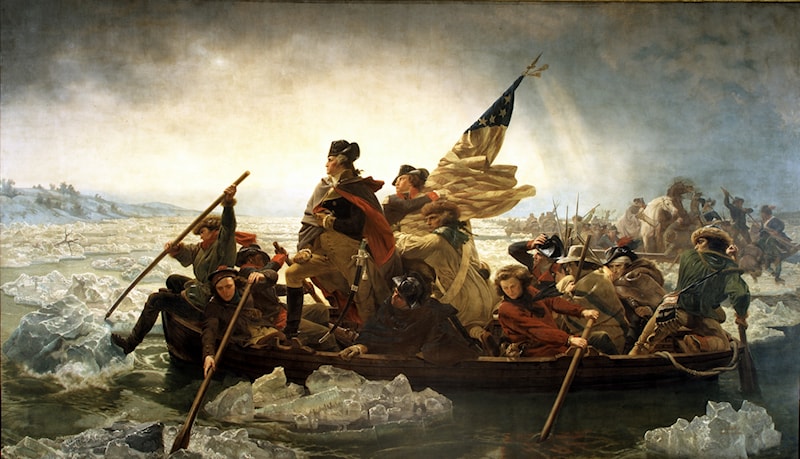
After the July 4 Declaration, New Jersey became a battleground within months. The British took New York in August 1776 and pushed Washington's army across the state and into Pennsylvania. On Christmas night 1776, Washington crossed the Delaware River from Pennsylvania back into New Jersey and surprised the Hessian garrison at Trenton, the famous victory that saved the Revolution from collapse. A week later he won at Princeton.
New Jersey's decision to authorize independence on June 21 was not academic. Within six months, Hessian mercenaries were quartered in Trenton and British regulars were burning New Jersey towns.
The Declaration Signers
New Jersey's new Provincial Congress sent five delegates to Philadelphia with instructions to sign the Declaration of Independence. Three of them were famous in their own right. Richard Stockton, a lawyer from Princeton, would be captured by the British months after signing and treated so brutally in prison that he never fully recovered. John Witherspoon was the president of the College of New Jersey, later Princeton University, and the only active clergyman to sign the Declaration. Francis Hopkinson was a lawyer and musician who also designed flags, including quite possibly the first American flag.
The other two New Jersey signers were John Hart and Abraham Clark, Hunterdon County farmers who had never served in Congress before. They were rushed to Philadelphia in late June with one job: sign the Declaration on behalf of their state.
The Garden State
New Jersey's path to independence was unusual because its royal governor had fought so hard to stop it. Most royal governors fled the country or were simply ignored. William Franklin refused both options. He kept signing official documents. He kept issuing royal proclamations. He acted as if he were still in charge right up until the Provincial Congress put him under arrest.
By doing that, Franklin accidentally clarified the situation. New Jersey could not simply drift out of the British Empire the way some other colonies had. It had to formally break with the crown, because the crown's representative was still there, in his residence, refusing to leave. June 21, 1776, was the day that break became official.
We commemorate New Jersey on our 50 State Heritage Collection ornament.